v1.38.1 — clearer cards, and what yesterday’s quick check said
A small follow-up to v1.38, mostly about saying things more clearly.
The calibration card used to show the voltage it found, with an arrow that looked like the miner would go there. Apply actually sets the found voltage plus a reserve. The card now points to what Apply sets and says the rest underneath, e.g. “found 1030 mV + 20 mV reserve · reserve capped at the starting voltage”. That cap is new information too: the reserve never takes a miner above the voltage it started from. A quick check is titled as such, and visitors who aren’t logged in are told how to apply instead of wondering where the buttons went.
WarpTune also checks voltages on its own while it runs. The card called that “Calibrating”, which made people (me included) think a calibration was running. It now says “Voltage check”, and at the voltage floor, where it keeps counting past its 200-share target, it says so instead of showing “405/200”.
The first real quick check ran yesterday on my BitForge Nano: both stages in 1 h 50 min instead of most of a night. At 650 MHz the chip errors went 0.45 → 0.52 → 0.96 % from 1050 down to 1030 mV and jumped to 3.1 % at 1020 mV, so it confirmed 1030 mV on 201 shares, the same voltage the full calibration had found a few days earlier.
Two smaller things: Admin → Workers shortens the address so the worker name stays readable, and a device added as NerdNOS that now runs WarpAxe no longer shows “HTTP 404”. The WarpTune guide has a Linux/systemd section now (someone asked whether it’s Mac only, it isn’t).
Still no mainnet block.
Repo: dvb-projekt/dvb-WarpPool: Rust Bitcoin solo mining pool — Stratum V1 + V2, PWA operator UI, signed reproducible builds - Forgejo: Beyond coding. We forge. · Changelog in the repo.
v1.39.0 — WarpTune vs. the hand point, and a ratchet I had missed
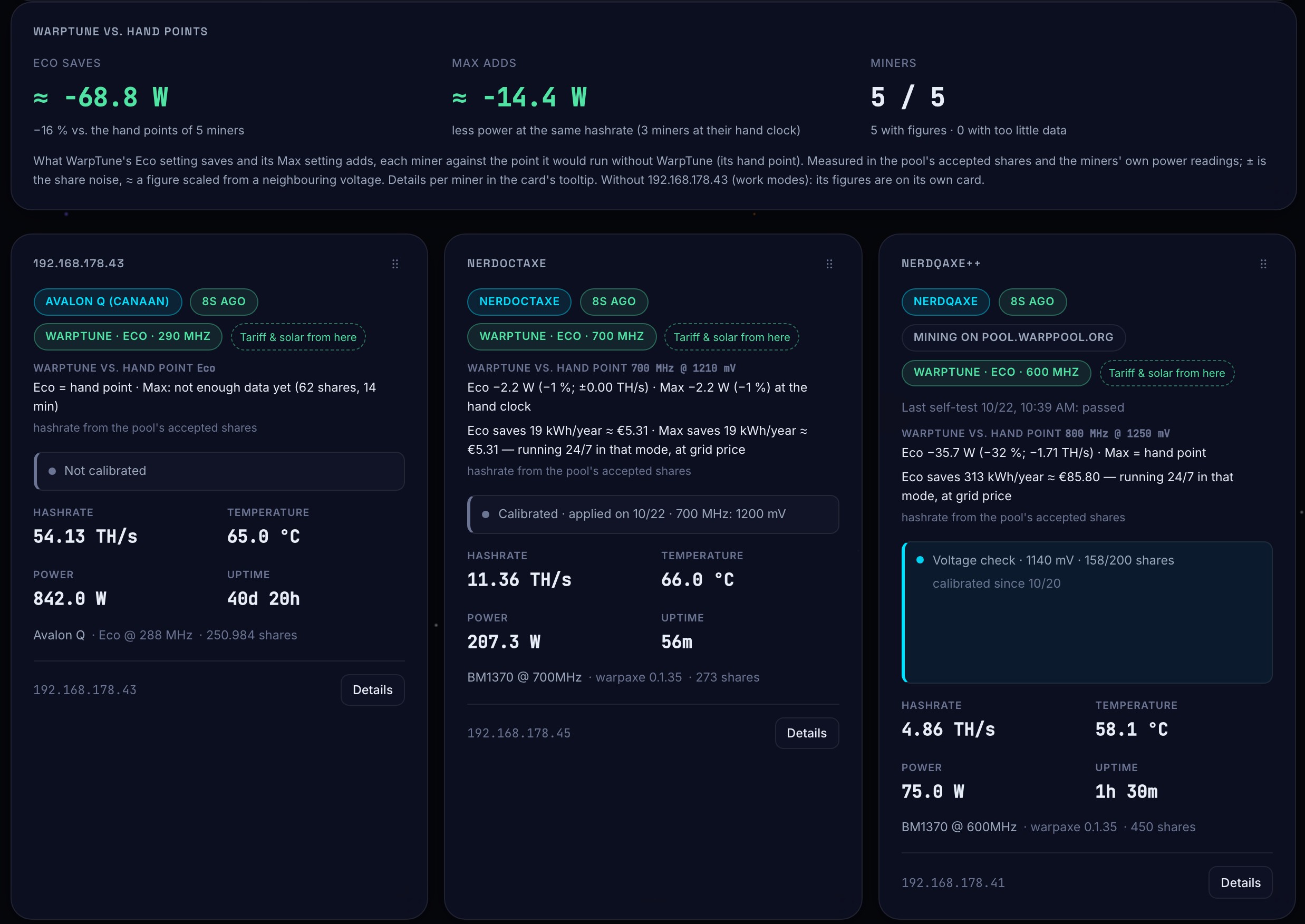
The device page now shows what the tuner gives you: per miner and in sum, what Eco saves in watts and what Max adds in hashrate, each against the miner’s hand point — the clock and voltage it would run without WarpTune. I went back and forth on the reference: the factory setting gives bigger and more comparable numbers, but for anyone who tuned by hand it would credit their own work to the tool, and on most of my miners it would have been an estimate. The hand point is the honest “without”, it is the factory setting for people who never changed it, and every miner has really run there, so it can be measured.
Measured means the pool’s accepted shares and the miner’s own power over the last week, a point counting from 200 shares and 30 minutes, with the share noise shown as ±. On my BitForge Nano the Max point (650 MHz) runs 8.2 W below its hand point at the same hashrate, the Bitaxe Gamma at 640 MHz 2.9 W below.
Building that turned up a bug. My NerdQAxe++ at its Eco clock had crept from 1140 to 1240 mV in three days, in 10 mV steps, while its chip error rate sat flat at 0.2 %. Each raise came from a 400-share vote at about 95 % of expected — inside the noise, but just under the bar — and the chip errors weren’t consulted because the error trigger was off. Now a near miss with flat chip errors counts as noise, not as a deficit, and such raises walk back down.
Still no mainnet block.
Repo: dvb-projekt/dvb-WarpPool: Rust Bitcoin solo mining pool — Stratum V1 + V2, PWA operator UI, signed reproducible builds - Forgejo: Beyond coding. We forge. · Changelog in the repo.
v1.39.1 — restores that respect the board
A user ran a Bitaxe GT with a hand point of 850 MHz at 1221 mV, about 64.5 W on a board built for 60 W. After every reboot WarpTune put that point back, then pulled the miner down again as urgent. WarpTune already held restores under the core-current line; it now also holds them under the lower of the board’s power limit and max_watts. If the hand point itself is over the limit, it restores the highest step under it, never above the hand voltage, and says so at start and on the card.
Stock ESP-Miner and NerdOS don’t report a core-current line, so on those boards the current went unchecked. There is now a small table of lines from the reference firmwares (ESP-Miner’s device config and TPS546 settings, NerdOS boards via WarpAxe’s profiles), used only when neither the firmware nor the config names one, and never to raise a line. The card shows the current against its line and says when it gets close.
One of my own miners needed the escape hatch: the NerdQAxe++ still reports the 100 W from NerdOS while it runs about 110 W on a 124 W supply, so there is a per-miner board_limit_w for firmwares whose figure isn’t the board’s.
The tuner is also a separate download now, for people who run the pool on Umbrel or Docker and only want WarpTune on another machine.
Still no mainnet block.
Repo: dvb-projekt/dvb-WarpPool: Rust Bitcoin solo mining pool — Stratum V1 + V2, PWA operator UI, signed reproducible builds - Forgejo: Beyond coding. We forge. · Changelog in the repo.
Patch-Release: In #mining-pools nichts. Im eigenen Forum-Thread optional eine Zeile:
v1.39.2: the calibrate buttons were missing on WarpTune cards in a voltage check (now there), and image updates are smaller (about 62 MB instead of ~84 MB). Still no mainnet block.
v1.39.5 — limits from the hardware
Three releases in one, both about WarpTune behaving on real hardware. My Bitaxe Gamma was capped by a fixed 25 W in the config while its board allows 40 W and it runs on a 50 W supply. The power limit now comes from the hardware: 90 % of the board limit and 80 % of the supply, whichever is lower, next to the regulator’s current line and the temperatures, which were always there. The supply you enter at the miner counts first; several miners on one big supply split its rating between them. And the clock search is no longer a config switch: Calibrate opens a dialog where you tick whether to also look for a higher clock, with the ceiling and the limits shown.
The other half is calibration. On my NerdOctaxe it found 1180 mV good at 700 MHz and lost a chip domain at 1170 mV, then walked down after resuming and hit 1170 again. A voltage that dropped a domain is now off for that step, and the calibration continues by itself once the domain is back. A quick check on the NerdAxe Gaia had started below the voltage the tuner had already found necessary, and a tuner restart mid-stage produced a nonsense verdict; both fixed, with an audit over the changes before the cut. Still no mainnet block.
Repo: dvb-projekt/dvb-WarpPool: Rust Bitcoin solo mining pool — Stratum V1 + V2, PWA operator UI, signed reproducible builds - Forgejo: Beyond coding. We forge. · Changelog in the repo.
v1.39.6 + v1.39.7 — every share once, and a calibration that ends
Two fix releases, both found by measuring rather than by reading code.
v1.39.6: I ran the open-pool-benchmark harness locally against the pool. Its work audit flagged that one connection got byte-identical work twice under a new job id: when the block notice and the regular template refresh fetched the same template within one second, both went out. A miner could then submit the same header under both ids and have it counted twice. For solo that only inflates the stats, for a shared payout it would not be acceptable. Identical work is now dropped before it gets a job id (V1 and V2, both template sources), and the share check also keys on the header. Seven audit runs since, no duplicate work. I’ve also sent the adapter upstream so others can run the same harness against it.
v1.39.7: My Bitaxe Gamma’s calibration found 1040 mV good at 640 MHz and 1030/1020 mV bad. The re-check at 1040 came back good again, but since the tuner held 1030 off for two hours after its second failure, the step had nowhere to go and sat at 99 % with “401 of 200 shares”. A good re-check over a voltage that can’t be tried again now ends the step with its result, a step that gets no verdict despite twice the shares it needs ends with what it has, and stopping a calibration early keeps the steps that already finished, ready to apply or discard. 1727 tests. Still no mainnet block.
Repo: dvb-projekt/dvb-WarpPool: Rust Bitcoin solo mining pool — Stratum V1 + V2, PWA operator UI, signed reproducible builds - Forgejo: Beyond coding. We forge. · Changelog in the repo.
v1.40.0 — WarpTune Desktop
A new member in the forum asked how to use the tuner on his Mac — “more a mechanic than a coder”. Fair point: until now WarpTune meant a terminal, a config file and, for the calibrate buttons, a pool of your own. v1.40.0 changes that.
WarpTune now serves its own page on your computer. A setup assistant searches the network, shows what it reads from each miner and adds it in dry run, so nothing is written until you decide. Switching a miner live asks once and names the limits: never above the voltage you set by hand, never below the regulator’s clean range, within 90 % of the board and 80 % of the power supply. Calibration, the clock-search checkbox and apply/discard work on that page the same way as in the pool.
There’s a macOS app, a Windows installer (no admin rights) and Linux packages. I tested them on Windows 11, a fresh macOS VM and my own Mac. They aren’t signed with a paid certificate — the release has SHA256SUMS with a cosign signature, and the handbook has a picture guide for the first start: WarpTune Desktop: First Start - dvb-WarpPool
Before the cut a separate review went over the whole thing — local page security, config writing, the launcher on all three systems, the packaging — and everything it found is fixed. Still no mainnet block.
Release: Releases - dvb-projekt/dvb-WarpPool - Forgejo: Beyond coding. We forge.
v1.40.1 — WarpTune Desktop fixes
I’m writing a manual for WarpTune Desktop, and going through every screen showed five places where the page promised something the tuner didn’t do. v1.40.1 fixes them:
- The network search found AxeOS-style miners only. An Avalon Q answers on its cgminer port instead, so it never showed up. The search now asks that port too, read-only, and lists the Q.
- The BitForge Nano runs the maker’s fixed presets, so a calibration only makes sense with the clock search. Until now that needed a line in the config file. The device card has a switch for it now, and the calibration dialog keeps the clock search on and says why.
- The Energy mode needs a dvb-WarpPool energy page. Without one it could be picked but not saved; now it’s greyed out with the reason.
- An Avalon Q’s live switch talked about clock and core voltage. On a Q, WarpTune only switches the maker’s work modes, and the text now says so.
- The question when you stop a calibration still said everything measured so far is lost. Since v1.39.7 finished steps keep their result.
The new texts are in all eight languages. The manual follows once the screenshots match this release. Still no mainnet block.
Release: Releases - dvb-projekt/dvb-WarpPool - Forgejo: Beyond coding. We forge.
v1.41.0 — WarpTune calibrates on any pool
With v1.40 I wrote that WarpTune Desktop needs no pool of your own. That was true for regulating, but not for calibration: the calibration judged each voltage step by the accepted shares a dvb-WarpPool reported. v1.41 closes that gap.
WarpTune now reads the accepted shares and their difficulty straight from the miner, on whatever pool it mines. That’s the same arithmetic it used with the pool’s numbers. If you do run dvb-WarpPool, its worker row is still preferred and adds the reject reasons. Firmware that doesn’t report the pool difficulty can’t be calibrated this way, and the card says so. If the difficulty on your pool is so high that a step can’t collect enough shares before its timeout, WarpTune refuses the start and shows the numbers.
The savings card works without a pool too now, and it shows the saving per year: in kWh, and in money once you enter your electricity price. On my Nano that’s about 74 kWh a year at the same clock and hashrate, roughly €20 at my tariff.
Before the cut a separate review went over the whole change. It had no critical or high findings, and everything it found is fixed. A test on my own Gamma found two more small issues, also fixed. Still no mainnet block.
Release: Releases - dvb-projekt/dvb-WarpPool - Forgejo: Beyond coding. We forge.
By the way: each project has its own page now, warppool.org, WarpTune Desktop — keeps each Bitcoin miner at its best point and WarpAxe — open-source firmware for Bitaxe and Nerd miners.
Update v1.42 – WarpTune says why it paused
A small update. If WarpTune stops writing to a miner on its own, for example because its write breaker saw too many writes in an hour, the card now names the reason and the time, and “Switch writes on again” resumes it without restarting anything. A miner restart no longer counts against that breaker. WarpTune also reads the stop limits WarpAxe reports and brakes 1 °C before the firmware does, and it is ready for the upcoming WarpAxe self-test. Downloads as before: WarpTune Desktop — keeps each Bitcoin miner at its sweet spot
dvb-WarpPool v1.42.1: a small fix. After a WarpAxe self-test, v1.42.0 lost track of the miner and stopped tuning it; v1.42.1 reads its data correctly again. Please update before the upcoming WarpAxe v0.1.34.
State October 2026 – what dvb-WarpPool can do today
This thread has grown one release at a time, so here is the whole picture for anyone who lands here now. Release notes will keep coming below.
What it is. A self-hosted Bitcoin solo pool, written from scratch in Rust, AGPLv3. 0 % fee by default. The block reward goes through the coinbase straight to the finder’s address – no accounts, no custody, no payout ledger. You can run it privately for your own miners, for a fixed group of friends over TLS, or as a public 0 % pool in per-worker mode, where every visiting miner mines to their own address.
Mining core
- Stratum V1 (plain and TLS 1.3) and Stratum V2 (Noise-encrypted, extended and standard channels), plus a V1↔V2 translator.
- VarDiff that remembers each worker’s difficulty across reconnects and restarts, with per-class starting points – a NerdMiner gets sub-1 difficulty so it still sends a share about every 30 seconds.
- Templates via getblocktemplate + ZMQ, or Bitcoin Core’s IPC interface (Core ≥ 31) as an opt-in.
- BIP-34, SegWit commitment, BIP-310 version rolling, and a BIP-54-ready coinbase locktime.
Operator UI
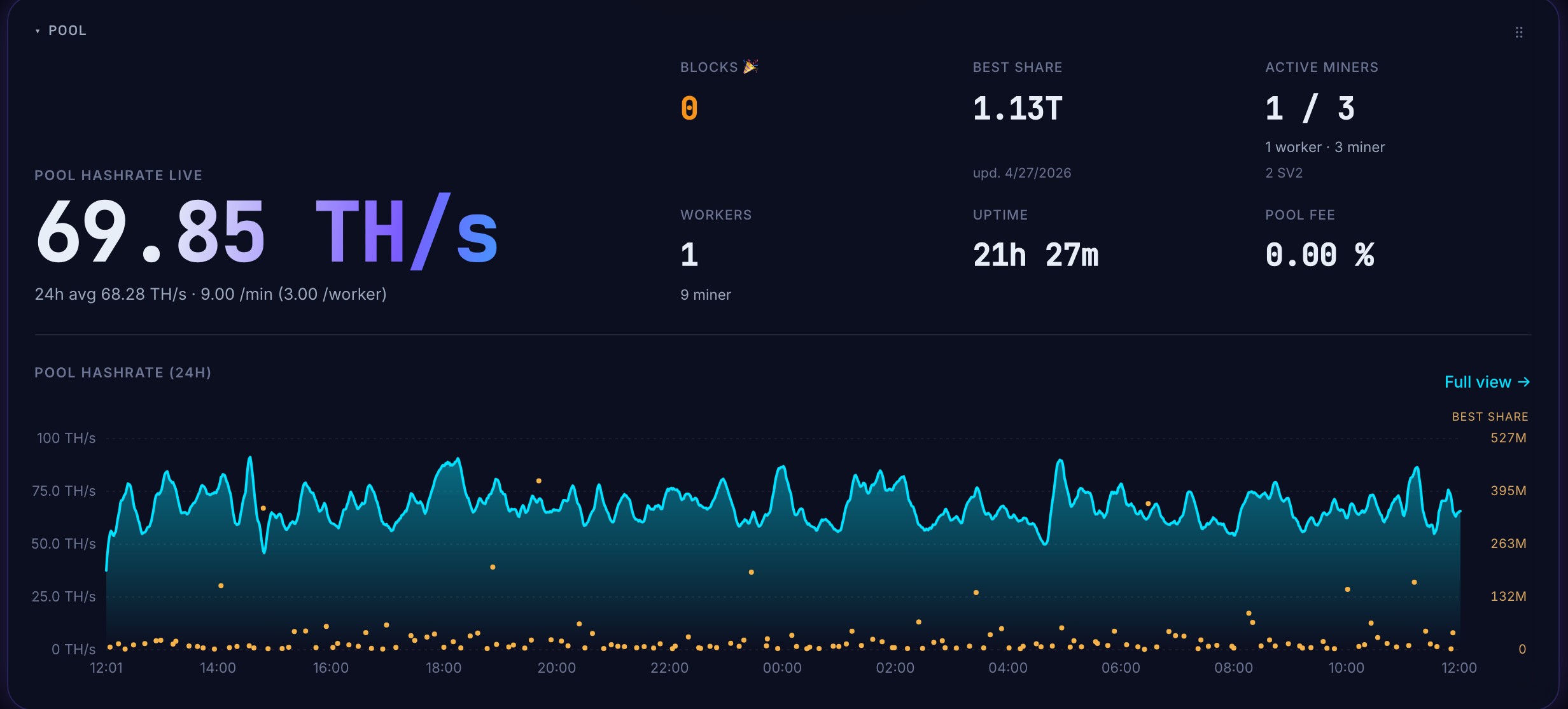
- A PWA in eight languages with live updates: hashrate chart with best-share dots, worker list, a screensaver for a wall display.
- Devices tab with telemetry from AxeOS, NerdNOS and several ASIC firmwares, LAN discovery via mDNS, and WarpTune’s badge and calibration button per miner.
- Notifications via ntfy, Telegram, Discord, Slack, email or Web Push.
- Energy: tariff, running cost, and where each kWh came from – solar, home battery or grid.
Public pool pages (per-worker mode)
- A login-free page per address, also as ckpool-compatible JSON for existing displays.
- A block odds panel – chance in 24 hours, within a year, the 50/50 point, luck so far – with no countdown and no near-miss framing.
- An owner panel unlocked by signing a challenge in your own wallet (BIP-137, or BIP-322 for Taproot): privacy toggle and personal alerts.
Install and trust
- Umbrel community store, Docker (amd64 + arm64), .deb / .rpm / AppImage, macOS .dmg. Runs on anything from a Raspberry Pi 5 to a server.
- Cosign-signed, reproducible releases with SBOM; Argon2id, 2FA, scoped API tokens, audit log, opt-in access control; 1767 tests gate CI.
Highlights of the last weeks (v1.36–v1.42.1)
- WarpTune moved into the Devices tab: one-button calibration (v1.36) and “WarpTune vs. hand point” per miner (v1.39).
- Admin → Workers removes an idle worker with its best shares and VarDiff memory (v1.38).
- Sv2 direct channels now start and floor at the miner-class difficulty, like V1 (v1.37.1), and the pool drops byte-identical work instead of sending it twice under a new job id (v1.39.6).
Honestly: the project’s own public pool, pool.warppool.org, has not found a mainnet block yet. The block path (per-worker coinbase, Bitcoin Core accepts the block, the finder is paid) is verified end-to-end on regtest. Solo is a lottery.
Overview: dvb-WarpPool — Self-hosted Bitcoin Solo Mining Pool
Docs: https://docs.warppool.org/
Public pool: pool.warppool.org:3333 (V1), :3334 (V1 + TLS), :3336 (Sv2) – your BTC address as the worker name.
Questions and test reports are welcome here.
Update v1.44.0 – found blocks reach Bitcoin Core faster, and Core checks the block assembly
When a miner finds a block and the pool takes its templates from Core over IPC (Core ≥ 31), it now hands the block back the same way: submitSolution on the template the job came from, with just the header fields and the coinbase, instead of the whole block as hex through submitblock. On regtest with Core 31.1 that took 29 ms instead of 66 ms for a 1.5 MB block. submitblock stays as the fallback, and whether Core accepted the block is read from its confirmations in the chain.
New as well: on the first job after start, then on every 6th new block (roughly hourly) and on every new block after a reject, the pool builds a test block exactly like its real ones and hands it to Core as a BIP 23 proposal, so Core checks everything except proof of work. The dashboard shows the result. The first checks on mainnet passed, on the public pool and on an Umbrel. GBT setups without ZMQ now get new blocks right away through a long poll instead of on the next refresh (30 s by default).
Still no mainnet block. Release: Releases - dvb-projekt/dvb-WarpPool - Forgejo: Beyond coding. We forge.
Update v1.45.0 – found blocks survive a node outage, and miners fall back when the node stops delivering
A found block is now written to <data_dir>/block-spool/ beside the submit (fsynced, never delaying the IPC submitSolution). If the submit gives no final verdict – Core unreachable, restarting or behind, inconclusive – the pool keeps sending submitblock to every configured node with backoff until one accepts it or has it in its active chain, rejects it for real, or the chain has moved on. The spool is replayed on start, so a pool restart in that window does not lose the block either. After an accepted or inconclusive block of ours, the pool also sends preciousblock to every node.
New as well: when the template source (GBT or IPC) has delivered nothing for 10 minutes, the pool tells every miner, disconnects V1, TLS and Sv2 together and refuses new connections until templates arrive again. Firmware then switches to its fallback pool and comes back on its own (AxeOS probes the primary every 60 s). On by default; [server] node_unhealthy_disconnect = false keeps the old behaviour, and miners without a fallback pool sit idle meanwhile.
Smaller items: Sv2 shares may now differ from the job’s version only in the BIP 320 bits (0x1fffe000), otherwise invalid-version; on V1, two shares that differ only in rolled version bits are no longer a duplicate. PROXY protocol v1/v2 on all Stratum listeners (trusted sources only), a “Miner software” card from the user agents, alerts (operator notification sinks plus the address owner’s notify target) when a known miner is pointed at another pool or logs in with another payout address, and on per-worker pools an owner-set coinbase text (≤ 16 ASCII characters, byte budget checked per template).
1847 tests. Still no mainnet block. Release: Releases - dvb-projekt/dvb-WarpPool - Forgejo: Beyond coding. We forge.
v1.45.1 is out, a small patch on top of v1.45.0:
- The “Miner software” card now counts only miners that are hashing; sessions that send no shares are left out. The pool’s own latency probe no longer shows up in it.
- WarpTune: the solar-surplus reserve can be set per miner (
surplus_reserve_w under the miner’s [[miner]] entry). An Avalon Q keeps its 300 W; small miners can use 210 W and step up on less surplus. Keep it above the pool’s own 200 W surplus buffer, or the step up can use up the surplus that allowed it.
- A small fix in the block spool’s start-up cleanup.
Release: v1.45.1 - dvb-projekt/dvb-WarpPool - Forgejo: Beyond coding. We forge.
v1.46.0 is out. This one is for Avalon Q owners who run WarpTune:
- Schedule: off-windows put the Avalon in standby (about 46 W). WarpTune stores the wake time in the miner itself before it sends it to sleep, so it wakes on time even when your computer sleeps or WarpTune is down. Quiet windows run it in Eco with a fan cap, which is lifted at once when the chips get close to their limit. Every day or on chosen weekdays, several windows a day, optionally only within a date range.
- Standby instead of Eco when there is no solar surplus (Energy mode, needs a solar source behind the pool). A safety wake is stored in the miner, so it never sleeps for good.
- Hang watchdog, off by default: awake, pool alive, work arriving, but no hashrate for 10 minutes → one restart, at most once an hour and three times a day. Node or pool outages never trigger it.
- The card shows the fan, the hardware error rate and the power supply; the pool shows a sleeping Avalon as “Standby until HH:MM” instead of a fault.
All of it stays off until you set it up on the Avalon’s card in WarpTune Desktop (“Schedule & standby”). I checked the miner commands it uses by hand on my own Avalon Q first.
Release: v1.46.0 - dvb-projekt/dvb-WarpPool - Forgejo: Beyond coding. We forge.
v1.46.1 is out, a small patch for the Avalon Q schedule in v1.46.0. Our own live test on an Avalon Q turned up two bugs:
- After the Avalon woke on its own at the end of an off-window, its standby and wake times stayed in the device. WarpTune now clears them; times you set yourself in the Avalon app are left alone.
- WarpTune mistook the 2–3 minutes before the board hashed again for a dead chip and tried to restore it. It now waits for the hashrate after a wake or boot.
Re-tested on the same Avalon: woke on time, times cleared, full hashrate after about 5 minutes. The Avalon’s card now shows what WarpTune did (hours in Super on solar surplus and hours in standby over the last 7 days) instead of the hand-point line.
Release: v1.46.1 - dvb-projekt/dvb-WarpPool - Forgejo: Beyond coding. We forge.
v1.47.0 is out. The main changes:
Umbrel + Stratum V2: the Sv2 port moves from 34254 to 18336. On 29 Oct the system had taken 34254 for an outgoing connection, so the app could not start. 18336 lies below Linux’s range for outgoing ports and is the port of the official store format. If your miners use :34254, switch them to :18336. The authority key stays the same, and the V1 ports are unchanged.
Share crediting: a share is now credited at the difficulty it met, never above. After a standby, an Avalon Q’s difficulty rose fast, and shares it was still finding against the old target were credited at the new difficulty. On the chart that showed as a false 2 PH/s spike. After a pause the difficulty now also returns to its old level in one step.
WarpTune and a silent chip: on a NerdOCTAXE-γ one of 8 chips fell silent mid-run, and WarpTune read the 88 % hashrate as an unstable clock. It now judges the hashrate on the chips still running and marks no step bad. With WarpAxe firmware the firmware restarts the chain; with stock firmware WarpTune restarts the miner after 10 minutes of silence, at most once an hour, and gives up after three failed tries (then at most once a day). Tested live with a muted chip.
Also in WarpTune:
- The current, input-voltage and power protections act within seconds after a change.
- A point set by another tool no longer marks a step bad.
- After a reboot in Eco the miner goes straight to its Eco point.
- WarpTune Desktop applies a saved setting at once for that one miner, and takes the electricity price from the pool if you have not set one.
Release: v1.47.0 - dvb-projekt/dvb-WarpPool - Forgejo: Beyond coding. We forge.
v1.48.0 is out. The main changes:
WarpTune calibration as a clock–voltage curve: every stage now walks down in 10 mV steps to the first failed step instead of stopping a fixed number of steps below the reference, and a reference that falls short is searched upward rather than given up. On the Eco side the search walks down from the Eco clock in 25 MHz steps and makes the clock with the best J/TH the Eco clock (at most three clocks down; it stops after two clocks in a row with no gain). From the live runs on my five miners: the NerdQAxe++ ended on 590 MHz at 15.28 J/TH instead of 600 MHz at 15.66, and the Bitaxe Gamma’s Max point at 640 MHz runs at 1070 mV instead of 1090.
WarpTune and WarpAxe: with WarpAxe v0.1.41 WarpTune sends the firmware a heartbeat about every two minutes while it regulates the miner. The firmware’s own regulation steps back and takes over again ten minutes after the last heartbeat, so a WarpTune crash never leaves a miner unregulated. The heartbeat only sets a timer in RAM (no flash write). Cases the firmware heals itself are left to it.
Write order: when clock and voltage both go down, WarpTune writes the clock first, waits until the chips report the new clock (or the ramp time), and only then lowers the voltage, so the chips no longer run the old, higher clock at the new, lower voltage.
Share votes: at 400 shares a healthy point misses a 95 % bar by chance about one time in six. A vote that is short by less than one sigma, with no second witness such as rising chip errors, now counts on to 800 shares before it decides.
Pool: for a self-signed certificate (the default on Umbrel) the connect dialog shows the SHA-256 of the TLS public key. WarpAxe shows the same value when it asks you to trust the pool, so you can compare the two. A CA-signed certificate shows none. The “auto” template source now switches to IPC as soon as Bitcoin Core’s socket answers and back to getblocktemplate if it stops delivering, without a restart.
Security note: the SQLite bundled through sqlx has advisory RUSTSEC-2026-0459. It is local only (it needs crafted files planted in the pool’s own data directory), so it is accepted for now; the fix comes with the next sqlx release.
Release: v1.48.0 - dvb-projekt/dvb-WarpPool - Forgejo: Beyond coding. We forge.
v1.49.0 is out. The main changes:
“No shares” alert: until now the pool only alerted when the Stratum connection dropped. A miner that stayed connected but submitted nothing (a frozen chip, stuck firmware) raised nothing. Now a worker that has submitted at least one accepted share gets one alert when the next one is overdue: 10 minutes by default (miner_no_shares_mins, 0 switches it off), or 20 times its own mean share gap where that is longer, at most 4 hours, so a CPU miner or a slow device with long random gaps is not reported for them. A worker is watched only once five gaps are known. A “mining again” message follows after three accepted shares in a row, also after a disconnect alert. Both go to the sinks with on_miner_disconnect (ntfy, Slack, Email). An Avalon in WarpTune’s standby is not reported (the pool reads the standby from the WarpTune snapshot it already polls). When the node is unhealthy and the miner gate drops every miner, the gate sends one message instead of a disconnect and a “back” per worker. V1, TLS and Sv2 go through the same watch. Open alerts live in memory and do not survive a daemon restart.
Avalon Q chips: the stock firmware’s estats reply (Q-25052801_14a19a2) carries per hash board one temperature, one voltage and one work counter per chip. WarpTune reads them, read-only: 160 chips in 4 strings of 40 on our Q. The status comes from each chip’s counter increase over a window against the board’s mean, with a margin of 4 sigma: dead after about 30 minutes standing still while the others move, weak below 90 % over the last 12 hours (at least 3 hours of history). In seeded simulations over 5 × 4 days of healthy chips with a daily reboot there was no weak or dead verdict; a chip at 70 % reads weak after about 4 hours, a chip at 92 % never. A dead chip writes a journal line, weak is a hint on the card. Nothing is sent to the miner and the regulation is unchanged.
Chip error lines by chip type: the regulation’s lines now follow the chip as the calibration’s already did (BM1370 1.5 % up / 2.5 % down, BM1373 7 % / 9 %, every other chip 1 % / 2 %). A value in the config stands as before. Stock AxeOS reports the Bitaxe Naja Duo as BM1372/BM1373; a combined name now gets the BM1373 lines.
Smaller things: the Workers table shows the worker name whole on two lines; an open browser tab loads the page anew after an update instead of “500 Internal Error”; a mode change no longer trips the write breaker (the steps of one mode change count as one write, a flapping mode still meets it); every miner reboot is logged and journaled; a chip diode at its sensor ceiling (127.875 °C) counts as no reading; WarpTune Desktop no longer crashes after a curve calibration with several Eco stages; the Miner software card names the boards.
Security note: RUSTSEC-2026-0459 (bundled SQLite) is still accepted until the move to sqlx 0.9; it is local only.
Release: v1.49.0 - dvb-projekt/dvb-WarpPool - Forgejo: Beyond coding. We forge.