WarpAxe v0.1.33 is out. It’s a small release: every text in the web UI and on the device display was proofread in all eight languages, in a full first pass and then a second one by independent editors. Two outright errors were fixed along the way: a Japanese help text said the opposite of what the setting does, and a hint pointed to a switch in the wrong place. The installer page and the manuals got the same treatment. Updates are fast again, too: about 60 s on a NerdQAxe++ instead of 2½ minutes. T-Display-S3 owners: the update to v0.1.33 still takes the slow path and sits at “verifying” for about 5 minutes. Leave it alone; it restarts by itself.
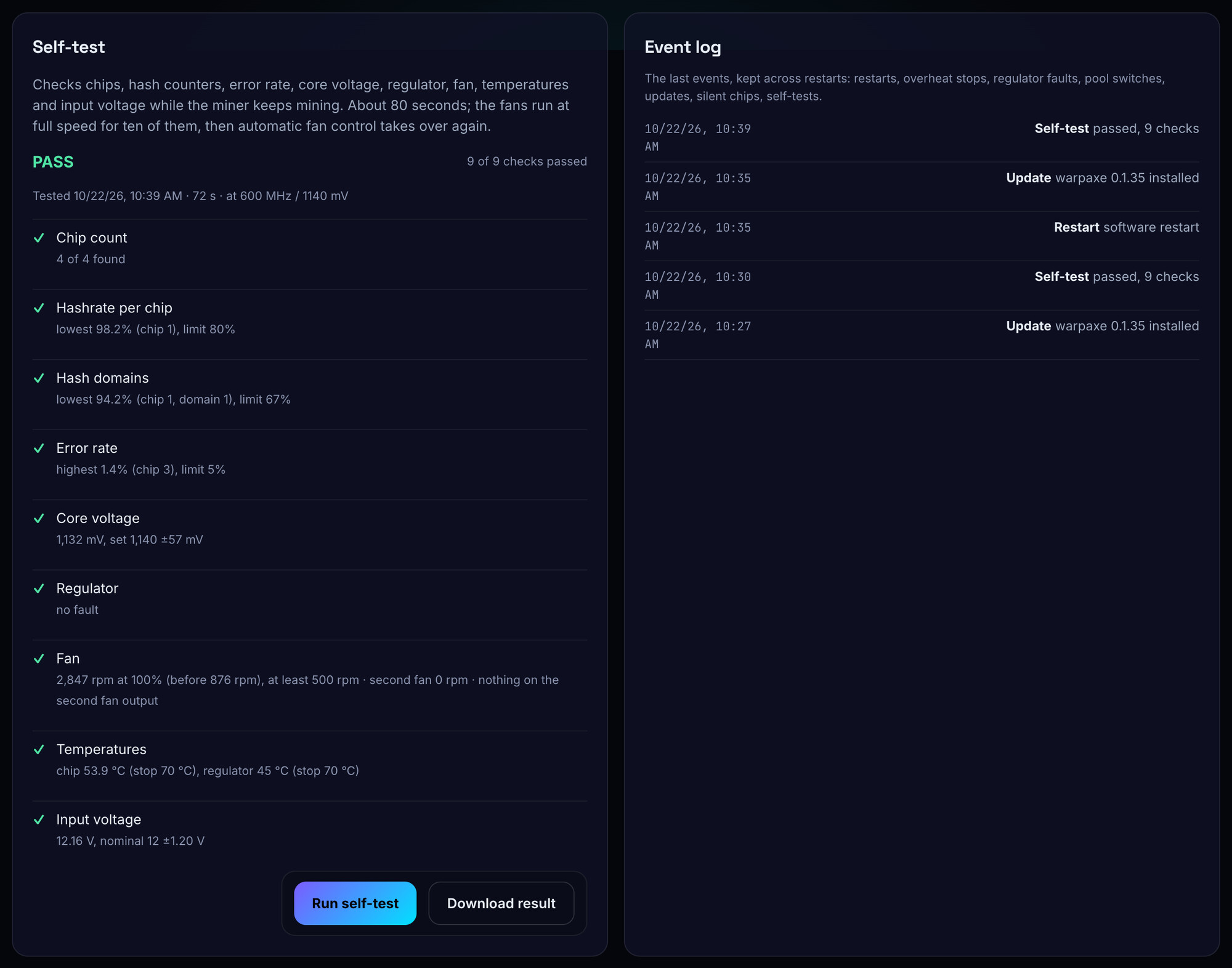
WarpAxe v0.1.34 is out, with a self-test like the one in AxeOS, except that it runs while the miner keeps mining: about 80 seconds, a ✓ or ✗ for each check (chip count, per-chip and per-domain hashrate, error rate, core voltage, regulator, fans, temperatures, input voltage), shown in the web UI, on the display and in the API. Also new: a diagnostics file for support (no passwords, wallet and Wi-Fi name masked), an event log that survives restarts, and a notice after a crash. If you use WarpTune, update it to v1.42.1 first.
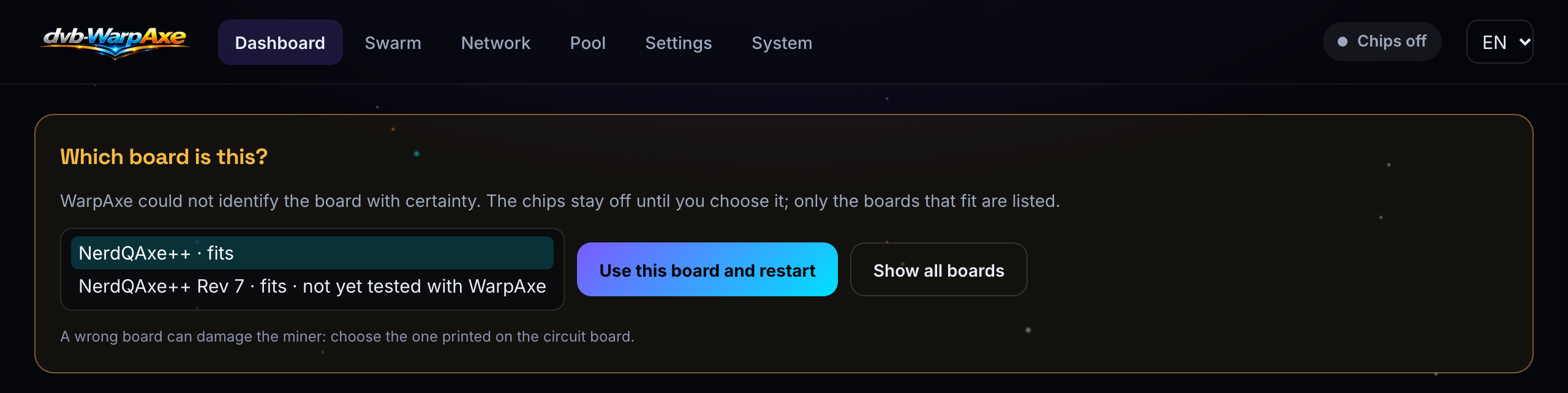
WarpAxe v0.1.35 is out. The main change is a safer first start: when the board can’t be identified for sure, the web UI offers only the boards that fit, checks the chosen one against the parts on the miner before any of its pins is switched, then starts the chips at a cautious voltage and counts them before the normal settings apply, followed by one self-test. The BitForge Nano and the NerdAxe Gaia are now recognised without asking, and the event log shows in the web UI’s language. Nothing changes for miners that already run WarpAxe.
State October 2026
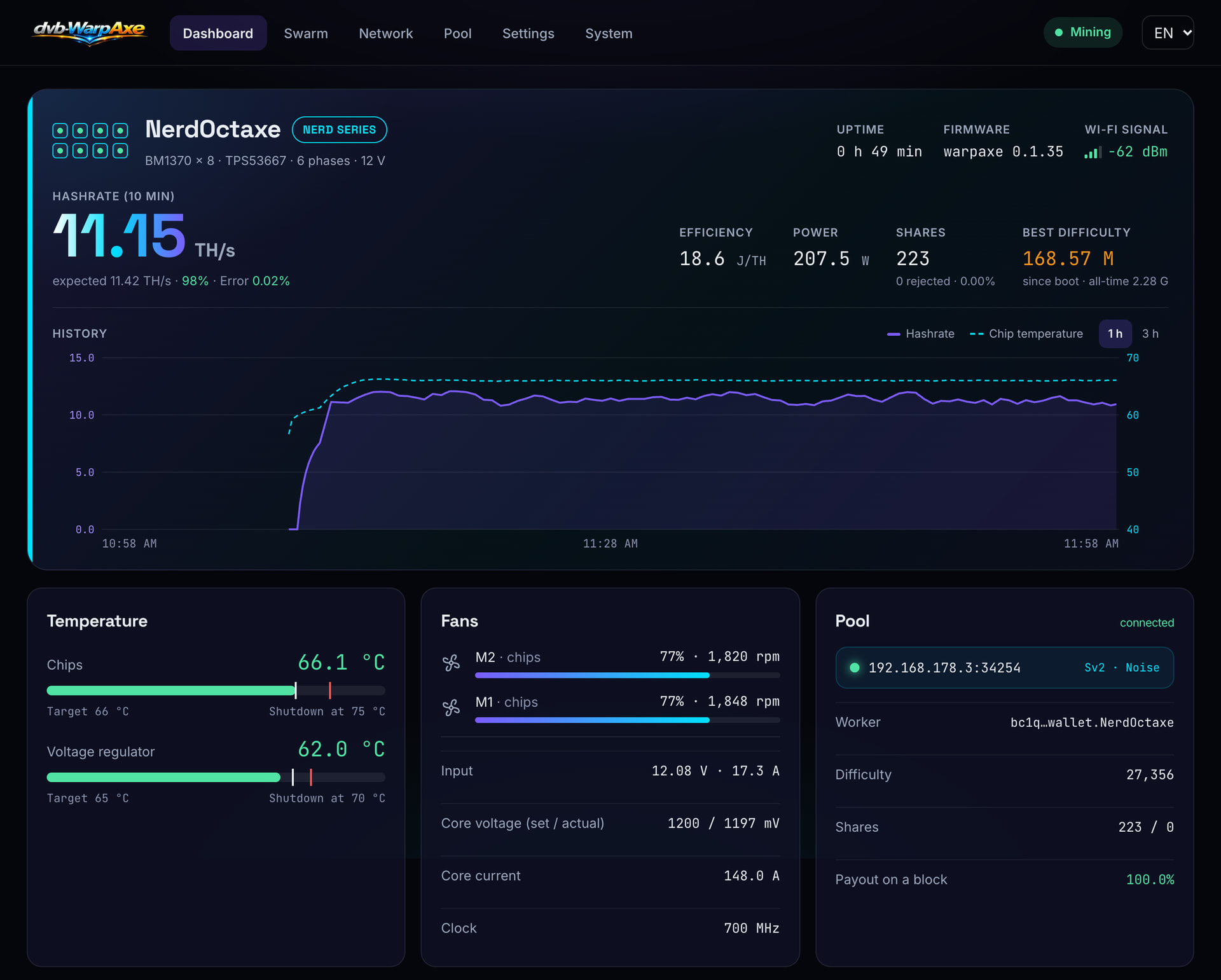
A first overview of what WarpAxe does, as of v0.1.35, grouped by topic. It is early firmware; corrections and questions welcome.
Boards
Runs 24/7 on my own Bitaxe Gamma, NerdQAxe++ (Rev 6.1), NerdOCTAXE-γ (Rev 3.1), NerdAxe Gaia, BitForge Nano and NerdNOS. Runs at users’ on a Bitaxe Gamma Duo, a Gamma Turbo and a NerdOCTAXE-γ v2.2. Profile only, not run yet: NerdQAxe++ Rev 7, Bitaxe Naja Duo, Bitaxe Gamma Hex, NerdAxe Gamma, NerdQX — only if you can restore the stock firmware over USB.
First start
One image for every board. The board is recognised, or the web UI offers only the boards that fit; either way it is checked against the parts on the miner before the chips get power, the chips start at a cautious voltage and are counted, then a self-test runs once. Wi-Fi, pools (AxeOS 2.15’s saved list too), clock, voltage, fan settings and temperature limits are taken over from AxeOS/NerdOS. Without a network: a WPA2 setup hotspot, password on the device display.
Mining and pools
Stratum V2 with the authority key checked, Stratum V1 with optional TLS, a fallback pool that hands back on its own, up to eight saved pools switched with one click and no restart, and a coinbase payout check that decodes the worker’s address for any SHA-256 coin (base58, bech32/bech32m, CashAddr).
Safety
Overheat stops checked for every board against its stock firmware (Bitaxe 75 / 105 °C as AxeOS, NerdQAxe++/NerdOctaxe 70 / 70 °C as NerdOS, plus a 105 °C regulator stop on the one-fan NerdAxe boards, where NerdOS has none); regulator faults (STATUS_WORD) shown with codes and handled like an overheat stop; implausible sensor and regulator readings rejected before the control loops see them; core voltage off before every restart and update.
Updates
The miner fetches releases itself; releases are signed, and one click installs after a SHA-256 and BIP-340 signature check. An update that doesn’t start rolls back (bootloader from v0.1.22). The browser installer saves a full flash backup of the stock firmware first and keeps the settings.
Diagnostics
Self-test on a click while mining (about 80 s, nine checks with their figures, in the web UI, on the display and in the API), a diagnostics file for support (no passwords, addresses and Wi-Fi name masked), an event log of the last 32 events across restarts, and a notice after a panic or watchdog reset.
Web UI, display, API
Web UI in eight languages, over Wi-Fi and over the USB cable; mDNS name like AxeOS; a read-only swarm page for AxeOS, NerdOS and WarpAxe miners and cgminer-API miners; a choosable display with a live view. AxeOS-compatible API, plus explicit states for tuners (chain stopped/starting, overheat cause, one-minute error rate, running self-test).
New in October (v0.1.31–v0.1.35)
Choosable display; overheat stops checked for every board against its stock firmware (before v0.1.32 a Bitaxe stopped too late, at 90 / 145 °C); saved pools; payout check for any SHA-256 coin; chip error rate on the dashboard; all texts proofread in eight languages; self-test, diagnostics file, event log and crash notice; a safer first start with the board check.
What the stock firmwares have that WarpAxe doesn’t
Far more boards and years of use by a large community. AxeOS: scoreboard, themes, the BAP port and Bluetooth Wi-Fi setup. NerdOS: two-factor login for updates, dual-pool mining, InfluxDB/Grafana export, alerts, a ninth language, and Ethernet in its v1.1.1 beta. If you need any of that, stay with the stock firmware.
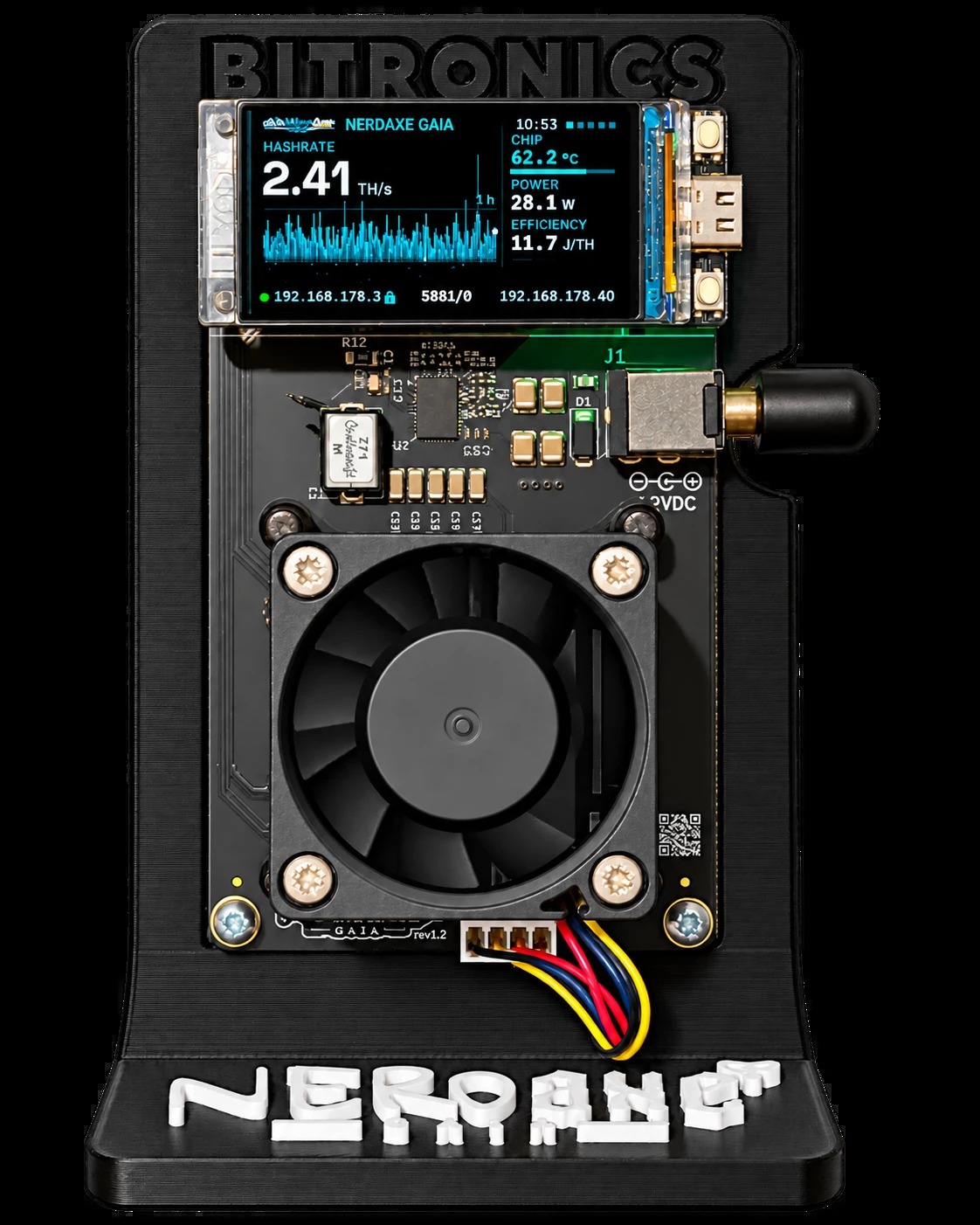
WarpAxe v0.1.36 is out, and this one is about the BitForge Nano.
I read ForgeOS v1.7, the Nano’s open-source stock firmware, and brought WarpAxe in line with it: the chip temperature sensor now uses ForgeOS’s diode ideality 0x37 instead of ESP-Miner’s 0x24 (measured back to back, 0x24 read 8.2 °C higher on the same chip), so the 75 °C chip stop applies where ForgeOS applies it (the 105 °C regulator stop has its own sensor and is unchanged), and the fan target moves to 52 °C, so chips and fans run as before; and the regulator warns at 38 A and shuts down at 40 A, with input over-voltage at 13.5 V, as ForgeOS sets them.
Also new, on every board: a pool asking for an implausible extranonce2 size is refused. Other boards keep their temperatures and limits.
WarpAxe v0.1.37 is out. It changes nothing in how the miner mines; it is about crashes. A user’s Gamma crashed in the restart at the end of an online update and left no core dump, so first: the core dump partition grows from 64 to 256 KB (it only comes with a USB install, since an online update never rewrites the partition table), and a panic now leaves “last words” (task, file:line, message; a stack overflow leaves its task name) in RTC memory that the next boot logs and the diagnostics file carries, dump or not. A crash during a restart is recorded with the step it happened in. That made our own Gamma show the likely cause: the interrupt watchdog (300 ms) firing during an NVS sector erase, which can take up to 600 ms, right before the reset; and a crash inside a flash operation never leaves a dump. The timeout is now 1000 ms. The user’s miner (v0.1.34) reported a panic rather than a watchdog reset, so this is likely, not proven. Also fixed: the false crash banner after every browser install since v0.1.34.
WarpAxe v0.1.38 is out; mining is unchanged. The main fix: System → Download mode crashed on every entry up to v0.1.37. TinyUSB was uninstalled while stdout still pointed at its CDC port, and the next log line (typically from esp_wifi_stop) hit a deleted mutex and asserted. Flashing still worked, but the next boot showed a crash. The console now goes back to USB-Serial/JTAG first. The 256 KB core dump partition from v0.1.37 caught the full 70 KB dump that confirmed it. Also: the flashing tool’s reset out of download mode no longer reads as a crash, and the raw RTC reset cause is in the API and the diagnostics file. The core dump download masks the Wi-Fi, pool and hotspot passwords, the SSID and the worker names and addresses (same-length x, CRC32 recomputed); pool hosts and IPs stay. A second install request is refused while one runs. In the first five minutes after boot, the Sv2 connect waits up to 20 s for NTP, and a certificate that fails against a clock NTP hasn’t confirmed yet no longer counts towards the fallback.
WarpAxe v0.1.39 is out; mining is unchanged. A found block now shows in the web UI: a banner with height, coin and time on every page until dismissed in that browser, the all-time count in the best-difficulty tile, a “block” event in the log, and blocksFoundTotal / lastBlock in /api/system/info, with the count and last block kept in NVS across restarts (before, only the LCD showed it, and nothing survived a reboot). Also fixed: after a VarDiff raise, nonces the chips found under the previous, lower ticket mask were still arriving and were counted at the new mask, 256× too high on a BM1370 going from 1 to 256. A pool starting at 0.001 showed 3.2 TH/s on a Gamma whose own counter read 1.42 TH/s. For 2 s after a raise they now count at the old mask. Shares and pool credit were never affected, only the displayed and reported hashrate. Thanks to Rockem for both reports.
WarpAxe v0.1.40 is out; a healthy miner mines as before.
One silent chip: the chain watchdog already restarted the chain when every chip was silent for 60 s. A single chip that stops returning nonces while the others hash was only reported; on our NerdOCTAXE-γ one BM1370 of eight dropped out after 4.9 days at 700 MHz/1210 mV and stayed dark for almost two days until a reboot. Now, if one chip is silent for ten minutes while work goes out, the chain is restarted. At most one such restart an hour over all chips; a chip silent again before it has run an hour after each of three restarts is left alone until the next boot or a new clock/voltage point. Both timers stop while no work goes out. API: chipSilentRestarts, lastChipSilentRestart {chip, mv, uptime_s}, chipsGivenUp; chainSilentRestarts still counts only the all-chips case. Tested by muting one chip’s nonces in a test image: restart after exactly 600 s, all eight back, and WarpTune held 700/1210 throughout.
TLS: every TLS connection is now verified against a pinned bundle, curl’s cacert-2026-10-20.pem (118 roots), with ESP-IDF’s default and deprecated lists off. ESP-IDF v5.3.3’s full list still has emSign ECC Root CA - G3 and the Comodo/Sectigo AAA root. The release script checks that the compiled trust store is exactly that bundle. Because esp_crt_verify_callback only looks up the issuer of the topmost certificate, WarpAxe adds one rule in its own verify callback: a sent certificate whose subject and public key match a root in the bundle is that root (GTS Root R4 cross-signed by GlobalSign Root CA, as api.coingecko.com sends it, now passes; tested on the device).
Releases - dvb-projekt/dvb-WarpAxe - Forgejo: Beyond coding. We forge.
WarpAxe v0.1.41 is out; a healthy miner mines as before.
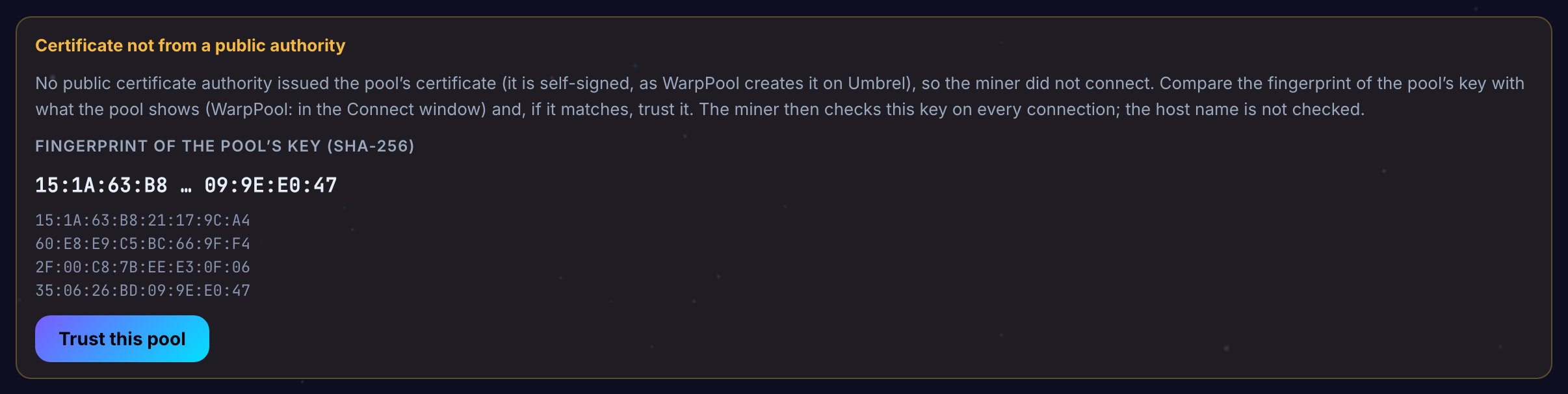
TLS pinning: WarpPool on Umbrel serves a self-signed rcgen certificate, which the pinned CA bundle of v0.1.40 can never accept. Rather than a custom-CA field, the pool connection now has a fallback: when the bundle check leaves the leaf “not trusted”, the firmware remembers the SHA-256 of the leaf’s DER SubjectPublicKeyInfo as pending (RAM only) and the Pool page asks to trust it. A click stores it per pool entry (main and fallback separately; a saved pool carries its pin). With a matching pin the verify callback accepts the leaf at depth 0 and ignores CN_MISMATCH, EXPIRED, FUTURE and BAD_MD; it never overrides REVOKED, KEY_USAGE, BAD_PK or BAD_KEY. A different key is reported as changed and never connects. The pin hook is attached only to the pool connection, not to the update or price clients. Tested on a NerdAxe Gaia against WarpPool on Umbrel, by IP and by name, plus a key change against a local self-signed server and a Let’s Encrypt pool with a pin stored (went through the bundle). That a saved pool carries its pin is covered by unit tests only.
Domain latch: the firmware reads the chips’ domain counters every second. A domain below 25 % of the mean of its siblings over a 10-minute window of fresh samples, while work goes out, triggers chips off/on through the existing path (reset, core and LDO off, on again; the Gaia keeps its LDO up). Shared 1/h limit with the silent-chip restart, given up after three restarts that do not hold for an hour, until the next boot or a new clock or voltage. Simulator tests only: a domain at 3 % is found and named, one at 50 % is left alone; no real case seen yet. selfHeals in /api/system/info tells WarpTune to wait in these cases.
That makes three cases the firmware heals on its own: the whole chain silent for 60 s, one chip silent for 10 min, one domain stuck for 10 min. The domain case is simulator-tested only. WarpTune v1.48.0 waits in all three; on stock firmware it heals the silent chip itself, not domains.
Long notify lines: no per-job copy of the coinbase any more (it was kept in up to 64 jobs, in pieces below ESP-IDF’s 16 KB PSRAM threshold, so they landed in internal RAM); the payout list no longer gives up above 64 outputs and is capped at 32 (own, SegWit commitment, then the largest, rest summed); a 512 KB line bound with reconnect; Sv2 up to one Noise record (65,519 bytes). Tested against a mock pool with up to 3,000 outputs (186 KB lines) and one endless line (reconnect in under a second).
Trust store and dates: emSign Root CA - G1 is dropped too (117 roots; the bundle is now derived from curl’s unchanged 2026-10-20 extract and checked in CI and in the release build). CONFIG_MBEDTLS_HAVE_TIME_DATE is on. The verify callbacks clear EXPIRED and FUTURE while NTP has not set the clock this boot, so a miner whose clock is not set yet still connects; a V1 TLS pool connect within 300 s of boot waits up to 15 s for NTP. The pin path ignores dates (see above), and so does the rule for a root the server sends along (it ignores the anchor’s dates). Devkit test: expired.badssl.com refused (leaf expired), badssl.com verified, update check and price fetch fine; the Gaia had NTP at 13 s and its pinned TLS session at 17 s.
Releases - dvb-projekt/dvb-WarpAxe - Forgejo: Beyond coding. We forge.
WarpAxe v0.1.42 is out; a healthy miner mines as before.
No pool, no hashing: a miner without a pool used to hash at full power for nothing. Once the main pool and, where one is set, the fallback have each failed at least twice and at least 60 s have passed since the first failure, the core rail goes down, the chain is held in reset (reset line low on every board) and the fans go to their lowest duty. A Wi-Fi or pool hiccup switches nothing. Both pools are then probed in turn every 30 s; the first job from either brings the chain back through the chain-restart path at the voltage it had and the configured clock. poolsUnavailable in /api/system/info (the name AxeOS v2.15.4 and ForgeOS v1.8 use), chainStopped, chainPhase NOPOOL; dashboard notice, display screen “NO POOL”, event log pools_out / pools_back. Nothing is written to flash per attempt. No pool or no worker configured counts the same. It does not apply during a self-test or the first start of a newly chosen board. On a Bitaxe Gamma the ASICs went off about 110 s after both pools were gone (5 W), and it was mining again on its own about 10 s after a pool answered.
Two changes in the connect loop come with it: a session that never brings a job counts as a failed attempt whatever its length (also for the switch to the fallback), and after two fallback failures both pools are tried in turn instead of the miner staying on the fallback.
Voltage after the clock ramp: a lower clock plus a lower voltage in one PATCH used to set the voltage within 100 ms while the PLL stepped down at 6.25 MHz per 100 ms (625 to 425 MHz: 3.2 s). The board task now holds a voltage drop while the chips’ clock is above the target and the request has not settled, 30 s at most; a raise, a voltage change on its own and the bring-up voltage’s drop go as before. The API refuses a clock below 50 MHz or without a PLL setting; a stored one is replaced by the board default at boot. NerdAxe Gaia, 380/960 to 350/950: the voltage stayed (955 mV read) until 350 MHz, then dropped, as the log lines show.
Found-block status: the find is now the header hash against the header’s own target as 256-bit numbers. The block’s hash and parent are stored; status pending at the find, confirmed when the pool’s work names the block as its parent, orphaned when the work for the next height names another one, unknown when the first work seen is two heights on. lastBlock.hash and lastBlock.status (null for older records); banner with short hash and, for BTC, a mempool.space link; events per status. The count stays in the record older versions read, hash and status in a second one, so a downgrade keeps the count. A block is stored once even on a chain at minimum difficulty. Not tested live (needs a found block); unit tests with real headers (genesis, blocks 1 and 2, 125552).
Second chip temperature: on the Naja Duo (2x BM1373) and the Gamma Turbo (2x BM1370) the EMC2103’s diode 2 is read too. Fan and overheat stop follow the hotter chip, as in ESP-Miner (either over 75 °C stops). temp is the hotter, temp2 the second chip’s own (-1 without a reading, as AxeOS), asicTemps both. A diode that read and then fails is unknown, never cool (fans full, lost-sensor stop after a minute); one that never reads after boot sets the fans to 100 % after a minute with a notice, and the chips keep running. The Gamma Hex is left as it was (diode 1 not taken for a chip). We have not run this on such a board; Gamma Turbo users, your temp2 and asicTemps would tell us whether diode 2 reads as expected.
Domain heal timing: a domain under 5 % of its siblings in the chain’s first window (180 fresh samples with work going out) is reset after about three minutes; 5 to 25 %, or a domain that dies later, keeps the ten-minute window. The three-minute case is tested in the chip simulator. The ten-minute reset of v0.1.41 has worked twice on a user’s Bitaxe Gamma: a domain at 0 % right after an update was healed, and all four domains were fine after. Both times the clock was well above stock. Same limits as before: one intervention an hour, shared with the silent-chip restart, given up after three that do not hold.
Self-test without pool work: hashrate, domains and error rate are skipped with the note noWork, the rest (chip count, voltages, regulator, fan, temperatures) is checked. The self-test may switch the ASICs on while no pool answers, for a bench test before a pool is set up.
Stratum V1 user agent: mining.subscribe sends warpaxe/ (), the same id as the Sv2 hardware field; bare warpaxe/ until the board is settled.
Also fixed while testing on the Gamma: with the core rail off, a diode that needs the chip’s power gave no reading and the lost-sensor stop fired; that count now runs only with the rail on, and after a real overheat stop the regulator and a minute off decide the restart, as on AxeOS. Diagnostics mask a worker’s bare address (it showed in the coinbase outputs) and no longer drop the info section for a numeric pool password such as “1000”. Event-log entries since v0.1.40 are now translated in all web UI languages; they showed in English before. WarpTune v1.48.0 already sends the clock before the voltage and holds off (no heal, no down-steps) while poolsUnavailable is true.

WarpAxe v0.1.43 is out, a fix release for what a user’s Gamma Turbo showed after v0.1.42, plus two fallback-pool fixes for every board.
Two-chip start (Gamma Turbo, Naja Duo): v0.1.42 began reading the EMC2103’s second diode. With the core rail off or the chips in reset, the second diode (chip 2 on the Turbo) reads the 11-bit ceiling, 127.875 °C. The EMC2103 averages each external diode over four conversions by default (datasheet 5.11.4), so right after the chips start the reading still carries those values: 108.375 = (3 × 127.875 + 50.4) / 4, then about 80 °C. v0.1.42 stopped on the first sample over the line. ESP-Miner stops on a single sample over 75 °C as well, but it does not switch the rail off at boot, so its readings are real from the start. v0.1.43 holds a second diode over the line for three samples after each chip start (rail on, reset pulse, chain init) with the fans at full; still over after that, it stops as before. Chip 1’s diode and the regulator keep their stop on the first sample. DIS_AVG is left as it is. A diode stuck at raw 0x3FF counts as no reading (fans full, the other chip keeps the stop line). On the user’s Turbo: 98.75 °C right after the start, 40.5 / 41.25 °C two seconds later, no stop.
Fallback worker name: mining.submit sent the configured main worker on every pool, so on the fallback ckpool returned “Worker mismatch” for 12 of 12 shares whenever the two worker names differed. It now names the worker the running session authorized as. The bug is older than v0.1.42.
Fallback without Wi-Fi: after a cold boot with an access point that took about a minute, the first pool attempts failed for lack of Wi-Fi and counted as the three failures that switch to the fallback. Attempts while Wi-Fi is not connected no longer count. The no-pool chain stop is unchanged.
Diagnostics: the device MAC and the BSSID are masked to the OUI. The web UI chip count falls back to the board’s (boardAsicCount in /api/system/info) while the chain has not counted, for example after an overheat stop before the chain start.
WarpAxe v0.1.44 is out: a clock of its own per chip, the Naja Duo on our bench, and a BM1373 addressing fix.
Clock per chip: on boards with more than one chip, chipFreqOffsets adds MHz to the frequency per chip. Each chip’s PLL goes out as a single-chip write and ramps without a chain restart; no chip passes its own target on the way (the shared part goes out as a broadcast only while all chips move in step). Limits per chip: the board’s maximum and half the base clock. On boards with chips in series (Naja Duo, Gamma Hex, NerdQAxe++ Rev 7) the offsets may lie at most 25 MHz apart, or 8 % of the base clock where that is less: the midpoint between the domains is not regulated, so a slowed chip takes voltage from the other. On a Naja Duo at 327 MHz (chips counted from 0), chip 0 at −25 MHz took chip 1’s error rate from 0.2 % to 1.36 %; chip 1 at −25 MHz took its own to 0.07 %; chip 0 at −60 MHz made chip 1 reset itself (its counters went back). On a NerdOctaxe at 625 MHz (chips in parallel), chip 2 at −25 MHz hashed about 4 % less, the other seven were unchanged. New per chip in /api/system/info: asicFrequencies, hashCount (cumulative, 2^32 hashes a step) and counterRestarts; for tuners voltageDomains and chipFreqOffsetSpread. For now the offsets are set by hand; a search in WarpTune comes later.
BM1373 addressing: ESP-Miner’s BM1373 init sends single-chip writes to the assigned address shifted right by two. Chip 0 sits at 0, so its writes land; chip 1 sits at 0x10 and its domain-end IO strength (0x58 = 0x0001F111) went to 0x04, where no chip is. Read back on a Naja Duo: chip 1 had 0x00011111. A single write to 0x10 reaches chip 1 alone, for 0x58 and the PLL alike. WarpAxe now writes to the full address; reported as ESP-Miner issue #2094. The Naja Duo has run on our bench since today and joins the tested list after some days.
Also: the two-chip boards’ diodes count only once the chain has answered after a reset or power-on (a Gamma Turbo read 72.75 °C before its chips had power); after a regulator fault on a board whose diode is dark while off, the chips come back after the minute with the regulator cool; the phase self-test skips a reading under 5 A total; a Naja Duo or Gamma Hex imported from AxeOS 2.15 no longer shows its screen upside down; the mining loop’s state moved to PSRAM, so more internal RAM stays free.
WarpAxe v0.1.45 is out: a clock and a night mode for the display, brightness in even steps, OLED burn-in protection, and the Naja Duo at its full limits.
Display: a clock page on the LCD (time, weekday, date, week, hashrate; below them the block height with price and fee, or pool and uptime without market data) and a clock slide on the OLED. Both are optional; the factory pages are unchanged, so the hashrate and the miner’s state stay up front. Night mode shows only the clock on black between two times of your choice and dims to its own brightness (off by default; 22:00–07:00 and 50 % when switched on). A key press brings the full display back for 30 s; a found block, an overheat stop, an update or a self-test still shows at full brightness. Time format: auto (12 h in the US, Canadian, Australian, New Zealand, Indian, Pakistani and Philippine zones), 24 h or 12 h.
Brightness: on the SSD1306 the contrast alone barely changes what you see between 100 and 50 %, so pre-charge and VCOMH now step down with it, and below 50 % the contrast follows a square curve. On the Nerd boards the backlight driver is an AW9364: it counts low pulses on its enable pin, one step of 16 each, wrapping round, and a low longer than 2.5 ms switches it off. A 5 kHz PWM on that pin steps it round and round; in our tests 75 % came out darker than 50 %. The firmware switches it off and on to reach a known level and sends the pulses for the one asked for. The Naja Duo and the Gamma Hex dim by PWM.
OLED burn-in: the frame is sent shifted through twelve positions (at most one pixel left or right, one up or two down), one step every ten minutes; every OLED screen in all six display languages fits inside the margin.
Naja Duo: the boot key steps the display pages (a hold of one second goes to the start page). IOUT limits 61/68 A from ESP-Miner master (#1992), maxPower 105 W (WarpTune takes 90 % of it as its power limit), clock options up to 550 MHz and the core voltage capped at 1120 mV, the maker’s own overclock voltage (WarpTune’s Max mode stops there; a higher stored voltage is set to 1120 mV at start), 6860 small cores for the expected hashrate (its counters read about 6900; ESP-Miner issue #2102), VOUT accepted up to 2 V per voltage domain.
Also: a power-supply sag watch (input voltage at rest against the median under load; a warning from an 8 % drop, report only); a hint when a “found block” below height 900,000 comes in while the coin is set to BTC; error-rate colours on the BM1373 (green < 5 %, yellow ≥ 5 %, red ≥ 9 %); a Bitaxe with a chip stop above 75 °C stored from before v0.1.32 saves its settings form again; a pool session whose share thread cannot start now ends instead of hashing without sending; the image is about 185 KB smaller than v0.1.44.